

 Arduino
Portenta H7
Best high-performance choice for advanced robotics and industrial automation engineers.

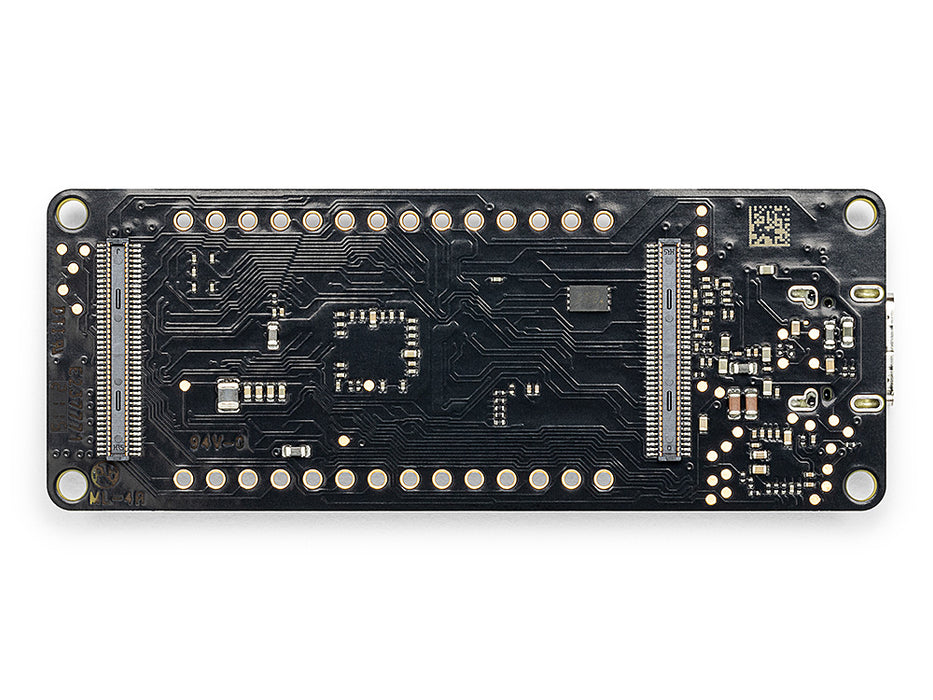
The Arduino Portenta H7 is a powerful dual-core microcontroller built for demanding applications. It features a STM32H747XI processor with a 480 MHz Cortex M7 and a 240 MHz Cortex M4 core, enabling simultaneous high-level and real-time task execution. Integrated WiFi and Bluetooth 5.1, along with a Secure Element, enhance its connectivity and security. This board is ideal for industrial control, robotics, and computer vision projects, offering robust performance and flexibility for embedded computing.
$99.00
Owner Satisfaction
4.5
/ 5
Category Rank
606
/ 1541
#606 in Development Boards
Price vs Category Average
+13%
Above average
Microcontroller
3274774
/ STMHXI dual Cortex®-M+M
Who it's for
- Engineers running complex real-time control and high-level operating systems
- IoT developers building robust industrial networking and connectivity solutions
- AI researchers deploying advanced machine learning and graphics at the edge
Who should skip it
- Hobbyists and budget-conscious developers seeking affordable prototyping hardware
- Beginners intimidated by complex inter-core communication and resource management
- Engineers designing power-constrained, battery-operated portable devices
Performance breakdown
Computational Power
Dual-core architecture handles complex industrial tasks with remarkable speed and efficiency.
Connectivity Versatility
Integrated WiFi, Bluetooth, and Ethernet provide robust options for any network.
Security Integration
Dedicated hardware security element ensures sensitive data remains protected at all times.
Machine Learning Capability
Native TensorFlow Lite support makes advanced edge AI projects highly accessible.
Analog Precision
High-resolution 16-bit ADCs deliver exceptional accuracy for precise sensor data acquisition.
Development Flexibility
Support for both Arduino IDE and MicroPython caters to diverse programming preferences.
Key Specs
Microcontroller
STM32H747XI dual Cortex®-M7+M4
Maximum Clock Speed
480 MHz
Memory
1 MB SRAM and 2 MB FLASH
Operating Voltage
3.3V circuit voltage
Connectivity
WiFi 802.11b/g/n and Bluetooth 5.1
ADC Resolution
16-bit (up to 36 channels)
Dimensions
2.60 in. x 1.00 in.
Operating Temperature Range
-40°C to +85°C
Features
- Dual-core processing for parallel tasks
- Integrated WiFi and Bluetooth 5.1
- Secure Element for hardware security
- Supports TensorFlow Lite for ML
- High-resolution 16-bit ADCs
- Onboard Li-Po battery charger
- MIPI DSI display interface
- Functions as an embedded computer
What customers say
The Arduino Portenta H7 earns praise for its exceptional performance and versatility, making it a top choice for advanced developers in industrial IoT and edge computing. Users value the dual-core architecture that enables sophisticated multitasking and the integrated connectivity options for complex networking. Its compatibility with the Arduino ecosystem is a significant benefit. A key highlight is the capability to run machine learning models via TensorFlow Lite for edge AI projects. However, sentiment is tempered by the high price, which limits accessibility for casual users. Some early adopters also noted a steeper learning curve and minor library maturity challenges. Overall, the H7 is recognized as a powerful, professional tool that delivers high performance for those ready to invest in its complexity and cost.
Know before you buy
The dual-core design allows you to run high-level tasks, such as complex calculations or communication protocols, on the 480 MHz Cortex M7 core while simultaneously handling real-time, time-critical tasks on the 240 MHz Cortex M4 core. This separation prevents heavy processing loads from interfering with your time-sensitive control loops.
Yes, the board is well-suited for machine learning. It supports TensorFlow Lite, allowing you to deploy and run inference models directly on the hardware for applications like computer vision or predictive maintenance.
The Portenta H7 includes an onboard Li-Po battery charger, making it easy to power the board using a rechargeable battery. You can also power it via the USB-C port for desktop development.
Yes, you can program the board using the familiar Arduino IDE. Additionally, it supports MicroPython, giving you more flexibility depending on your preferred development workflow.
The board features a MIPI DSI interface, which allows you to connect high-resolution displays directly. This makes it a strong candidate for projects requiring a graphical user interface or visual data output.
Absolutely. The Portenta H7 is rated for an operating temperature range of -40°C to +85°C and includes a Secure Element chip to ensure hardware-level security, making it reliable for industrial control and remote deployment.

Still have a question?
Ask Hayley anything about this product before you decide.