

 Adafruit
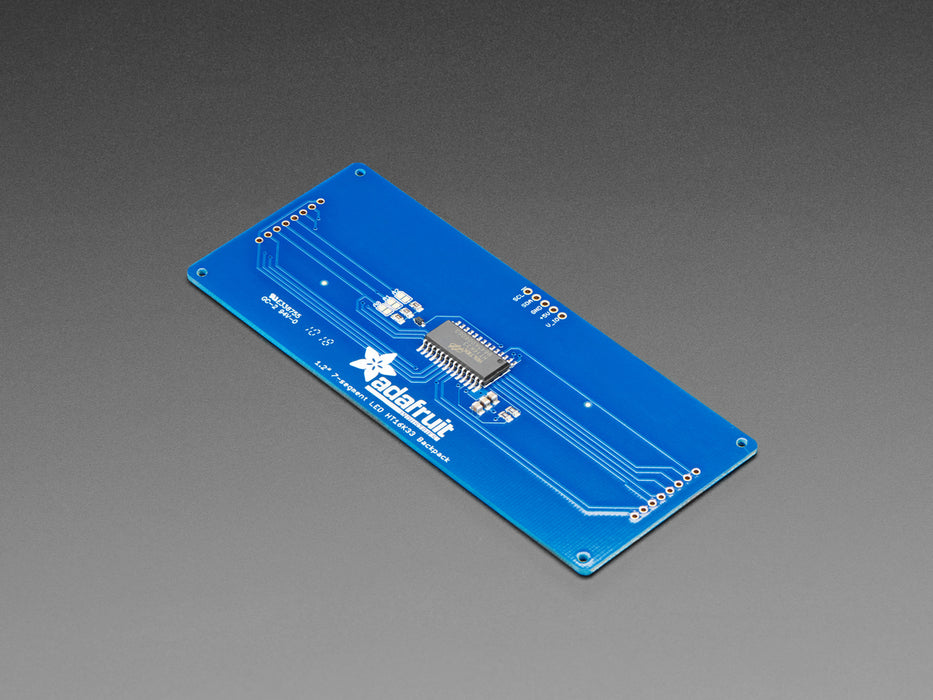
Adafruit 7-Segment Backpack - 1.2" Tall Digits
Best display driver for makers building custom large-format LED projects.

This Adafruit 7-Segment Backpack is designed for 1.2" tall digits and features an HT16K33 I2C LED driver for easy integration. It's stackable, allowing up to 8 backpacks on the same I2C wires. The updated board includes a 5V boost converter for brighter LEDs with 3.3V power and Stemma QT ports for plug-and-play connectivity. Some soldering is required for the header and display. Note that the 7-segment display itself is sold separately.
$9.95
Owner Satisfaction
4.7
/ 5
Category Rank
16
/ 775
#16 in Circuit Board Accessories
Price vs Category Average
-63%
Below average
Product Dimensions
120.050.04.0
/ mm x mm x mm
Who it's for
- Engineers building displays for long-distance viewing
- Makers needing to save pins on their microcontroller
- Developers looking to offload complex display logic
Who should skip it
- Budget-conscious hobbyists building large-scale projects
- Designers requiring full alphanumeric text capabilities
- Advanced users chaining many identical displays together
Performance breakdown
Integration Simplicity
Stemma QT ports make connecting to microcontrollers nearly instantaneous.
Scalability
Daisy-chaining up to eight units provides impressive display expansion capabilities.
Assembly Effort
Requires manual soldering, which may challenge absolute beginners.
Power Efficiency
Integrated boost converter ensures consistent brightness even on lower voltage inputs.
Software Support
Adafruit's dedicated library removes the headache of complex driver coding.
Build Versatility
Compact design fits well into custom enclosures and varied project layouts.
Key Specs
Product Dimensions
120.0mm x 50.0mm x 4.0mm
Product Weight
19.0g
Driver
HT16K33 I2C LED driver
Digit Height
1.2"
Connectivity
I2C, Stemma QT
Power Input
3.3V or 5V
Certifications
RoHS 2 2011/65/EU, RoHS 2 2015/863/EU
Dimensions
120.0mm x 50.0mm x 4.0mm / 4.7" x 2.0" x 0.2"
Features
- Easy I2C interface for simple microcontroller integration
- Drives large 1.2" tall 7-segment displays
- Stackable design for expanding display capabilities
- Address jumpers allow multiple backpacks on the same I2C bus
- Includes Adafruit's helpful LED Backpack Library for quick setup
- Requires minimal soldering for header and display attachment
- Updated with 5V boost converter for brighter LEDs
- Includes Stemma QT ports for plug-and-play
- Simplifies complex matrix display integration
- Compact form factor
What customers say
Customer sentiment strongly favors this 7-segment display due to its exceptional ease of use and superior display quality. The integrated I2C backpack significantly simplifies wiring and coding, making setup fast even for beginners. Users consistently praise the robust Adafruit libraries and clear documentation for quick integration with platforms like Arduino. The 1.2-inch digits offer impressive brightness and clarity, perfect for large format projects. While the initial cost is higher, customers agree the added convenience, reliability, and premium quality fully justify the investment, viewing it as a hassle free solution for clear numerical readouts.
Know before you buy
No, the 7-segment display is sold separately. This product is the driver board designed to power and control compatible 1.2-inch displays.
Yes, you will need to solder the header pins and the 7-segment display onto the backpack. While the Stemma QT ports allow for solderless connections to your microcontroller, the display assembly itself requires basic soldering skills.
Yes, the board is stackable. You can connect up to eight backpacks on the same I2C bus by configuring the address jumpers on the back of each board.
The boost converter allows you to power the board with 3.3V while still driving the LEDs at 5V. This ensures your display remains bright even when using a 3.3V microcontroller like an ESP32 or Raspberry Pi.
Adafruit provides an LED Backpack library that works with Arduino and CircuitPython. This library handles the complex I2C communication, allowing you to easily display numbers and characters with just a few lines of code.
The Stemma QT ports allow you to connect the backpack to your microcontroller without soldering wires. However, you still need to solder the display itself onto the backpack board before it can function.

Still have a question?
Ask Hayley anything about this product before you decide.