

 Digilent
Basys 3 AMD Artix-7 FPGA Trainer Board
Best entry-level platform for students learning digital circuit design.

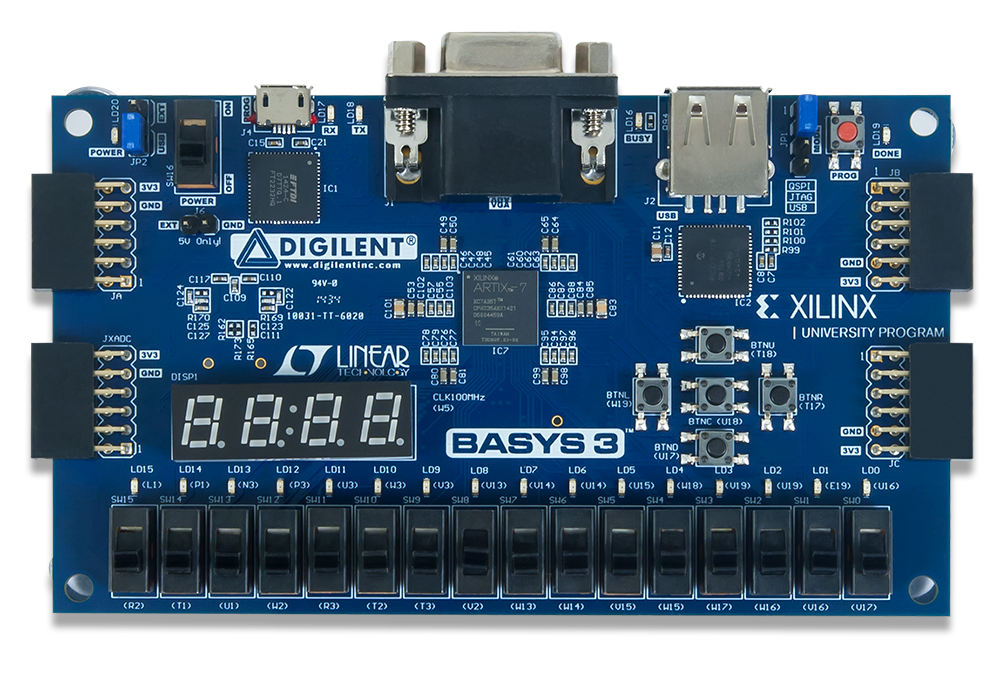
The Basys 3 is an ideal entry-level development board for those new to FPGAs, featuring an AMD Artix™ 7 FPGA. This ready-to-use platform includes integrated switches, LEDs, and I/O devices, minimizing the need for additional hardware. It offers ample uncommitted FPGA I/O pins for expansion with Pmods or custom circuits, all at an accessible price point. Designed exclusively for the AMD Vivado™ Design Suite, it supports designs with 33,280 logic cells and internal clock speeds exceeding 450 MHz, making it a powerful tool for digital circuit development.
$165.00
Owner Satisfaction
4.7
/ 5
Category Rank
28
/ 1546
#28 in Development Boards
Price vs Category Average
+88%
Above average
FPGA Part Number
7351236
/ XCAT-CPGC
Who it's for
- Engineers tackling complex digital logic and signal processing tasks
- Students needing immediate hardware feedback for hands-on learning
- Aspiring professionals building skills with industry-standard design software
Who should skip it
- Budget-conscious hobbyists seeking a more affordable entry point
- Developers requiring high-bandwidth interfaces for advanced professional projects
- Users preferring a simple, single-cable power solution for all designs
Performance breakdown
Learning Curve
Intuitive layout makes it the gold standard for FPGA beginners.
Hardware Integration
Onboard switches and displays eliminate the need for messy breadboarding.
Expansion Potential
Four Pmod ports provide ample room for custom hardware add-ons.
Software Compatibility
Seamless integration with Vivado ensures a smooth, professional development workflow.
Processing Capacity
Logic cell count is perfect for academic projects and prototyping.
Build Durability
Robust construction withstands the rigors of frequent classroom or lab handling.
Key Specs
FPGA Part Number
XC7A35T-1CPG236C
Logic Cells
33,280
Block RAM
1,800 Kbits
DSP Slices
90
Internal Clock Speed
Exceeding 450 MHz
User Inputs
16 switches, 5 pushbuttons
Outputs
16 LEDs, 4-digit 7-segment display, 12-bit VGA
Connectivity
USB-JTAG, USB-UART Bridge, 4 Pmod ports
Features
- Entry-level FPGA development board
- Complete digital circuit development platform
- Expandable with Pmod ports
- Supports free Vivado Design Suite
- On-chip analog-to-digital converter
- Integrated USB-JTAG for programming
- Onboard VGA output and USB HID Host
- Student-friendly pricing
What customers say
The Basys 3 Artix-7 FPGA Trainer Board is highly regarded as the premier tool for introductory and intermediate digital logic training, especially in academic settings. Users consistently praise its robust feature set, centered on the powerful Xilinx Artix-7 chip, which supports complex projects. The integrated peripherals, including switches, LEDs, and displays, are perfectly suited for immediate, hands-on learning and visualizing code execution. Reviewers emphasize the board's durable build quality and reliability for demanding lab use. While the development software setup can present initial complexity, the overall consensus is that the Basys 3 delivers exceptional value through high-quality components and long-term utility, making it an essential educational platform.
Know before you buy
The board is designed exclusively for the AMD Vivado Design Suite. You can use the free WebPACK edition to develop, simulate, and synthesize your digital circuits.
No, the Basys 3 is powered directly via the USB connection. This makes it convenient for desktop development without needing extra cables or power bricks.
Yes, the board features four Pmod ports that allow you to easily expand functionality with various sensors, displays, or communication modules. It also provides ample uncommitted I/O pins for custom circuit integration.
Absolutely. It is specifically designed as an entry-level platform, featuring integrated switches, LEDs, and a 7-segment display so you can start testing digital logic immediately without needing additional hardware.
The Basys 3 includes a 12-bit VGA port, allowing you to drive a display directly from the FPGA. This is ideal for projects involving video signal generation or basic graphical interfaces.
Yes, it features an integrated USB-JTAG programming circuit. This allows you to program the FPGA and debug your designs directly from your computer without requiring an external programmer.

Still have a question?
Ask Hayley anything about this product before you decide.